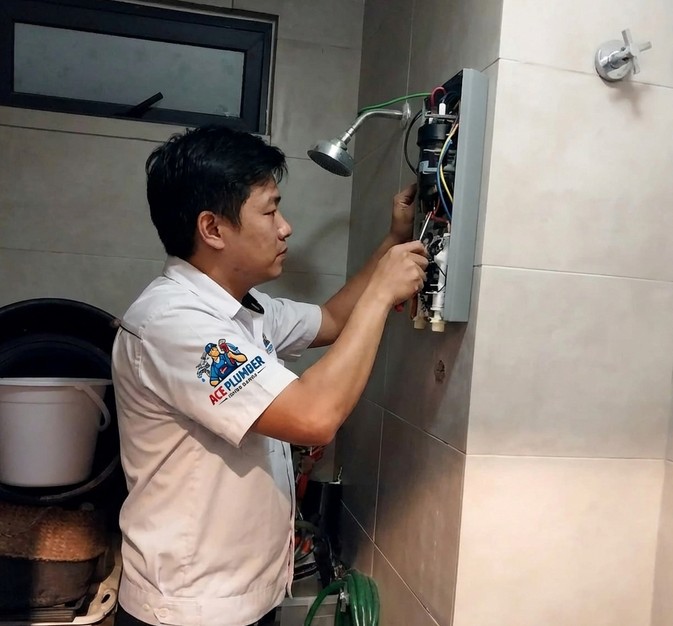
Water heaters are one of the highest-risk electrical appliances in any Malaysian home. They operate continuously, are installed in wet environments, and combine high-voltage electricity with water — a combination that demands proper installation, correct protective devices, and regular maintenance. Yet water heater safety is often overlooked until a problem occurs.
At Ace Plumber Johor Bahru, we install and service water heaters from leading brands including Joven, Alpha, and Panasonic. We also respond to emergency call-outs involving water heater failures and unsafe installations. This guide covers the essential safety practices that every Malaysian homeowner should understand.
Why the ELCB Is Non-Negotiable
The Earth Leakage Circuit Breaker (ELCB) — also referred to in modern installations as a Residual Current Device (RCD) — is the single most important safety device protecting you from electrical shock when using a water heater in a wet environment.
An ELCB continuously monitors the flow of electrical current through the circuit. If it detects even a tiny leakage of current — the kind that would flow through a person's body if they made contact with a live component — it cuts power to the circuit within milliseconds. This response speed is fast enough to prevent a fatal shock in most circumstances.
In Malaysia, the Uniform Building By-Laws and TNB requirements mandate ELCB protection for bathroom circuits. However, older homes — particularly those built before the 1990s — may have water heaters installed without adequate ELCB protection, or with units that have aged beyond their reliable service life.
- Every water heater in your home should be protected by a dedicated ELCB rated appropriately for the circuit load
- ELCB units should be tested monthly by pressing the test button — the circuit should trip immediately
- If pressing the test button does not trip the circuit, the ELCB has failed and must be replaced immediately
- ELCB units have a service life and should be replaced approximately every 8 to 10 years even if they appear functional
Annual Professional Inspection
Water heaters should be inspected by a licensed professional at least once every 12 months. An annual check by a qualified plumber or electrician covers the components and conditions that are not visible from the outside of the unit:
- Inspection of all wiring connections within the unit for signs of heat damage, corrosion, or loose terminals
- Testing of the thermostat and temperature cutoff device to confirm they are operating within safe parameters
- Inspection of the pressure relief valve (on storage heaters) to confirm it operates correctly and is not seized
- Checking of the earthing connection to confirm continuity
- Examination of the water inlet and outlet connections for mineral buildup or early signs of leakage
- Overall assessment of the condition of the unit against its manufacturer-rated service life
For brands such as Joven, Alpha, and Panasonic, manufacturer guidelines typically recommend professional servicing intervals aligned with this annual schedule. Adhering to this schedule is also important for maintaining any extended warranty coverage. For an example of a compliant setup, see our Mount Austin bathroom renovation, where we fitted a Joven instant heater with a dedicated ELCB.
Warning Signs That Demand Immediate Attention
Do not continue using your water heater if you observe any of the following:
- Tingling or mild shock sensation when touching the shower head, tap, or water — this indicates current leakage and must be treated as an electrical emergency
- ELCB tripping repeatedly when the water heater is switched on — this is a protective response indicating a fault within the heater or its wiring
- Burning smell from the unit or its electrical connections
- Visible water leakage from any part of the unit, particularly near electrical components
- Discolouration, rust, or corrosion on the exterior casing of the heater
- Inconsistent water temperature — water that is unpredictably scalding or cold can indicate a failing thermostat
- Unusual sounds such as popping, crackling, or hissing from inside the unit
Any of these signs warrant switching off the water heater at the circuit breaker — not just at the unit switch — and contacting a licensed professional before using the unit again.
Installation Requirements for Safe Operation
Safe water heater operation begins with correct installation. Whether you are installing a new unit or replacing an existing one, the following requirements must be met:
- Installation must be carried out by a licensed plumber and, for the electrical connection, a licensed electrical contractor
- The electrical circuit must be rated appropriately for the heater's power draw — undersized wiring is a fire hazard
- A dedicated ELCB must be installed for the water heater circuit — it should not share an ELCB with other bathroom circuits
- The unit must be mounted according to manufacturer specifications, with correct clearances for ventilation and service access
- For instant water heaters installed in enclosed shower areas, the unit must be positioned outside the defined splash zone as specified in the installation manual
- The water supply connection must include the correct pressure-reducing valve where supply pressure exceeds the unit's rated maximum
Instant Water Heaters vs Storage Water Heaters: Safety Considerations
Both types of water heater are widely used in Malaysian homes, and each has specific safety considerations that owners should be aware of.
Instant (tankless) water heaters — such as those offered by Joven and Alpha in their residential ranges — heat water on demand using a high-powered element. Because they operate at high power ratings (typically 3.5 kW to 4.5 kW), the electrical wiring and ELCB must be correctly rated. Instant heaters are also more sensitive to water pressure variation — low water pressure can cause the heating element to overheat if the flow protection switch fails.
Storage water heaters — such as those offered by Panasonic and Alpha — maintain a tank of hot water under continuous low-power heating. The additional safety concern with storage heaters is the pressure relief valve (PRV). This valve is designed to release water if internal pressure becomes too high. If the PRV is blocked, seized, or absent, a failed thermostat can theoretically allow pressure to build to dangerous levels. The PRV must be inspected annually to confirm it opens and closes freely.
For both types, age is a key risk factor. Manufacturers typically rate their units for 8 to 15 years of service life. A unit that has exceeded its rated lifespan should be assessed by a professional and replaced if it shows signs of deterioration — regardless of whether it appears to be functioning normally.
What to Do If You Suspect an Electrical Fault
- Switch off the water heater at the dedicated circuit breaker in your distribution board — do not rely solely on the unit's on/off switch
- If the ELCB has tripped, do not reset it until a licensed professional has inspected the unit and confirmed the fault has been resolved
- Do not attempt to open the water heater casing or inspect internal electrical components yourself — water heaters retain stored charge in capacitors even after power is removed
- Contact Ace Plumber Johor Bahru or a licensed electrician to assess the fault before returning the unit to service
Ace Plumber Johor Bahru installs and services water heaters from Joven, Alpha, Panasonic, and other leading brands across Johor Bahru. If you have any concerns about your current water heater — its age, installation quality, or ELCB protection — contact us to arrange an assessment.